Press
Press kit.
For reporters covering Oregon’s Housing in Unincorporated Communities rulemaking and the LCDC meeting August 27–28 in Salem. Everything here is sourced. On deadline? hello@protectruraloregon.com — say so in the subject line.
The one-liner
Protect Rural Oregon is a public-education and public-comment campaign by an informal network of rural Oregonians, focused on one state rulemaking — Housing in Unincorporated Communities — which could allow counties to expand and upzone rural communities outside urban growth boundaries.
Longer boilerplate, if you need it: the campaign publishes the state’s own numbers with sources, maps every one of Oregon’s 272 unincorporated communities, and helps residents put comments into the official rulemaking record before LCDC decides. Every factual claim is sourced on a public claim ledger.
Key numbers, with sources
272 / 223
Oregon has 272 unincorporated communities; 223 are designated under OAR chapter 660, division 22 — one of the four divisions this rulemaking amends.
Source: Statewide map dataset built from Oregon geographic data (retrieved July 2026); DLCD rulemaking page (divisions 4, 11, 14, 22)
491,347
New homes Oregon needs over the next 20 years, per the state’s own analysis. DLCD’s staff report to the commission puts it as “almost half a million homes.”
Source: Oregon Housing Needs Analysis, 2026 Production Targets (Dec 2025), p. 28; DLCD staff report to LCDC, April 2026 meeting, Item 5
April 23, 2026
LCDC approved initiation of the rulemaking — Housing in Unincorporated Communities — proposing to amend OAR chapter 660, divisions 4, 11, 14, and 22. It could allow counties to expand and upzone certain unincorporated communities.
Source: DLCD rulemaking page, oregon.gov/lcd/lar/pages/rulemaking.aspx
Aug 27–28, 2026
LCDC meets in Salem; DLCD lists the Aug 27 hearing on this rulemaking as hybrid — Basement Hearing Room, 635 Capitol St. NE, with a Zoom option.
Source: DLCD Commission Meetings schedule and rulemaking page (retrieved July 2026)
~$310,000
Median home sale price in the Illinois Valley — far below Oregon’s urban markets, which is why “rural land is off-limits” doesn’t explain rural unaffordability.
Source: Redfin ($307K) and RealtyTrac ($332,891), Cave Junction / ZIP 97523, retrieved 31 July 2026
The story, by page
- The affordability question
Our full answer to “won’t this build homes people can afford?” — steelman first, then the numbers.
- The rulemaking & claim ledger
What the proposal would allow, and the sourced status of every claim this campaign makes.
- The maps
Statewide and county maps: every community, designation status, zoning, and urban growth boundaries.
- All 272 communities
A page for every unincorporated community in the statewide dataset, by county.
- The timeline
Where the rulemaking is in its process, and every verified meeting with sources.
- About us
Who’s behind this, how we handle facts, and how to reach us.
Getting the names right
- The rulemaking
- Housing in Unincorporated Communities, amending OAR chapter 660, divisions 4, 11, 14, and 22. Initiated by LCDC on April 23, 2026.
- LCDC vs. DLCD
- The Land Conservation and Development Commission (LCDC) is the seven-member volunteer citizen commission that votes to adopt rules; its members are commissioners. The Department of Land Conservation and Development (DLCD) is the state agency that staffs the rulemaking and receives written comment. There is no “DLCD Commission” — that phrase is always an error.
- What to call us
- “Protect Rural Oregon” — an informal network of rural residents, farmers, and land-use advocates. We are not a coalition and we don’t speak for any organization, so please don’t attribute this campaign to one.
- The McCall quote
- If you quote the Tom McCall line the campaign uses, the verified primary wording is: “Heroes are not giant statues framed against a red sky. They are people who say: This is my community, and it’s my responsibility to make it better.” — Interview with Studs Terkel, in “American Dreams: Lost and Found” (Pantheon, 1980), p. 337. Variants circulating online differ; this is the book’s text.
Downloads
The maps are the campaign’s own renders from public data — free to publish with credit to Protect Rural Oregon · protectruraloregon.com. Photography on the site is licensed stock and isn’t ours to redistribute; for other imagery or higher resolutions, email us.
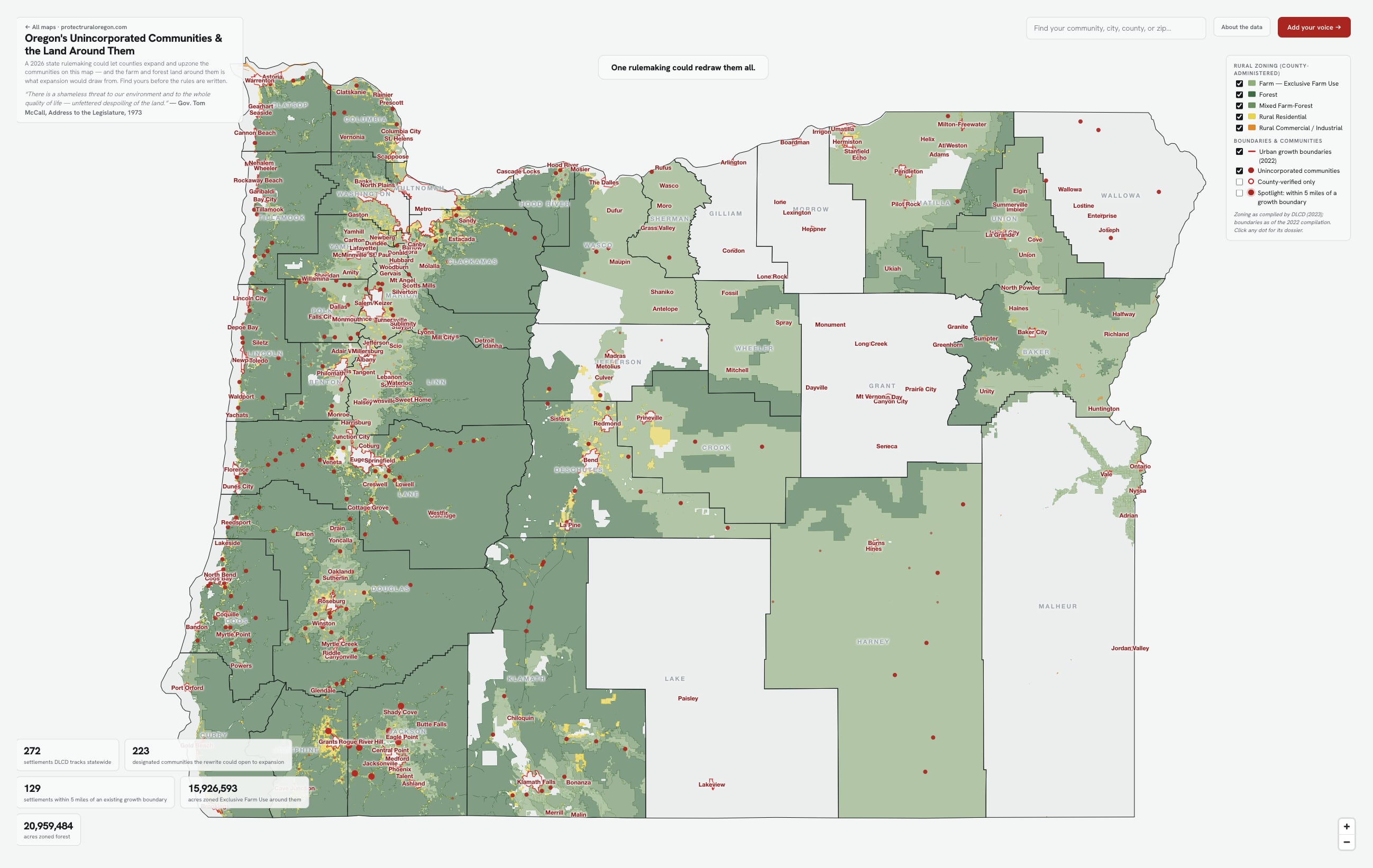
Statewide map — all 272 communities
2596 × 1642 · JPEG · the interactive map with zoning, boundaries, and key figures
Download ↓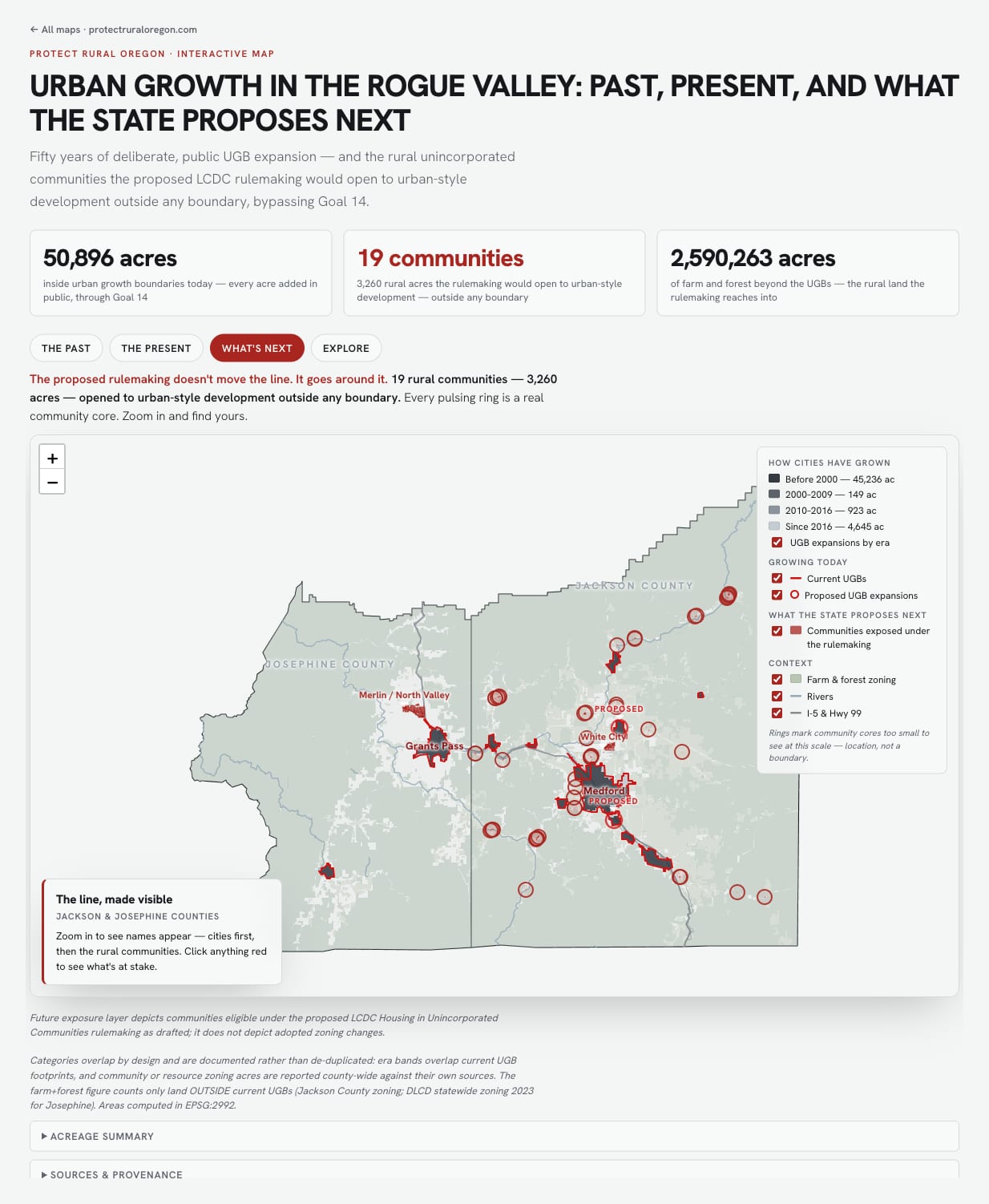
Rogue Valley — urban growth, past and proposed
1234 × 1502 · JPEG · fifty years of UGB expansion and the communities the rulemaking would expose
Download ↓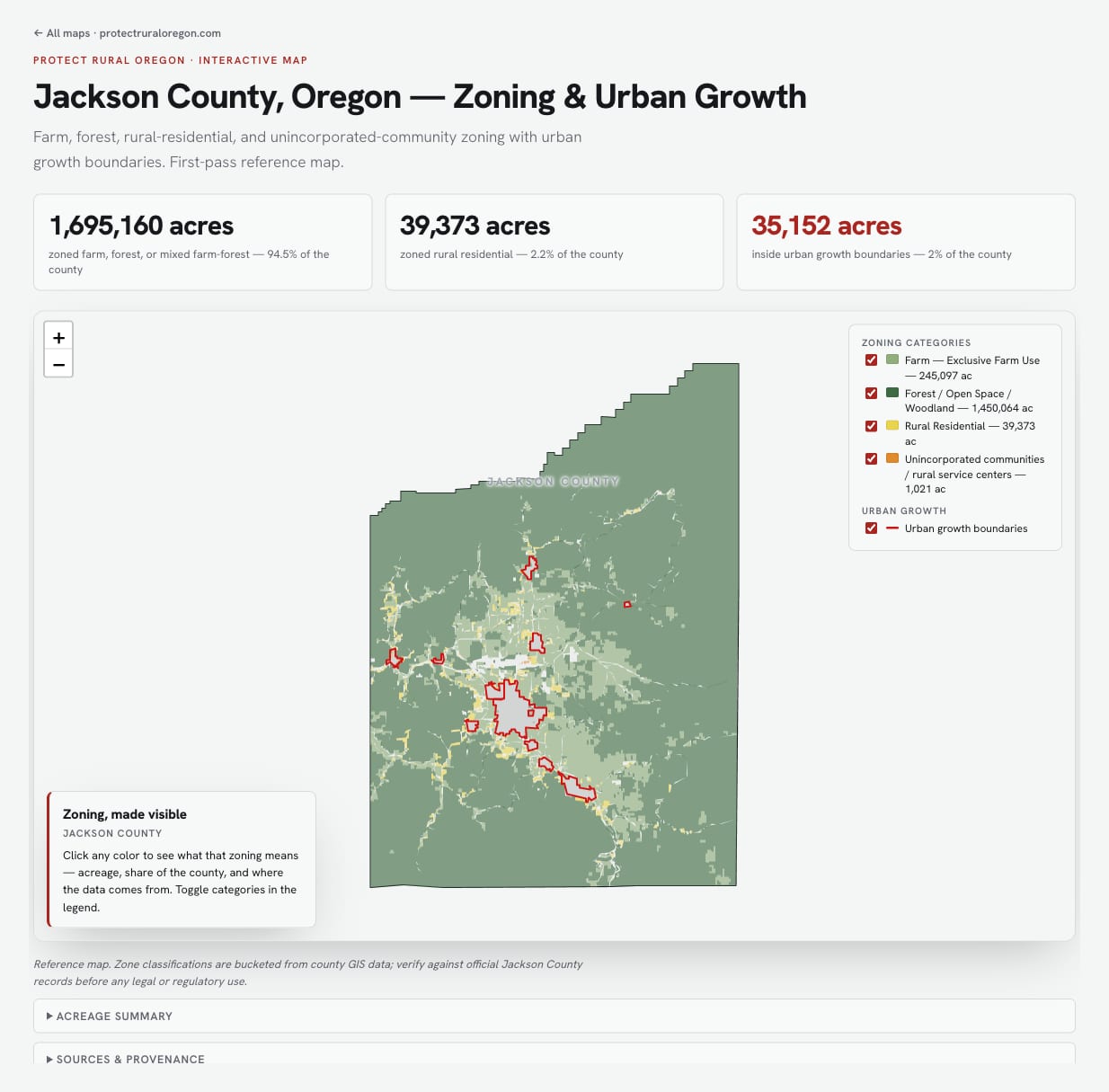
Jackson County — zoning & urban growth
1234 × 1215 · JPEG · county zoning with acreage figures
Download ↓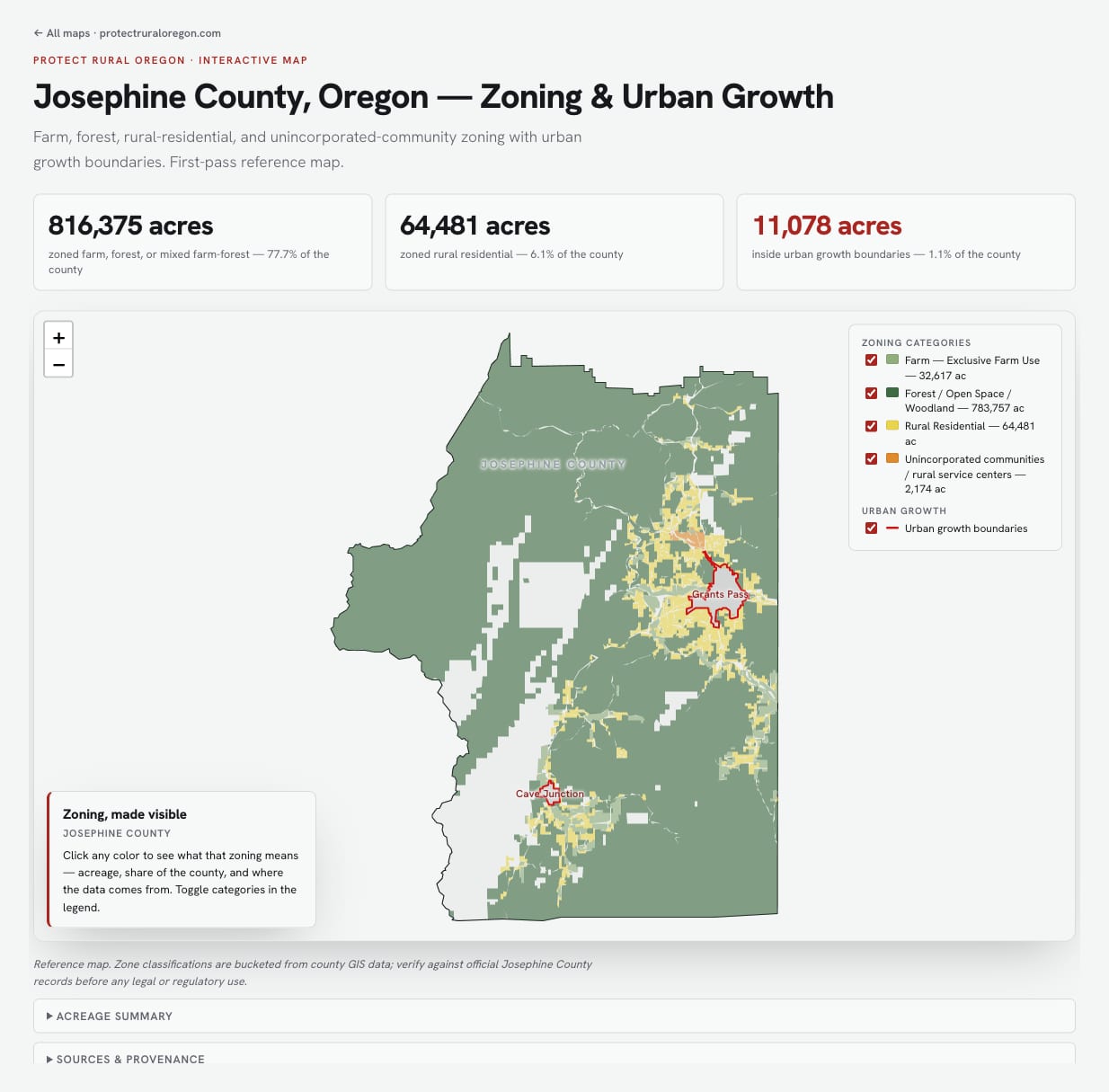
Josephine County — zoning & urban growth
1234 × 1215 · JPEG · county zoning with acreage figures
Download ↓
Print one-pager: the argument, the map, and the comment QR on one letter page (PDF, 500 KB) ↓
The mark: boundary-line mark (SVG) ↓

Contact
Interviews, background, data questions, corrections, or assets:
hello@protectruraloregon.comA person reads every message. Deadline requests are answered first.